White Tie Dress Code: The Most Formal Attire, Explained
There’s a specific kind of panic reserved for the invitation that reads “white tie” — because unlike almost every other dress code, this one gives you nowhere to hide and nothing to improvise. It’s the ceiling of men’s formalwear, a two-hundred-year-old uniform with almost no room for interpretation. This guide walks you through exactly what white tie is, the pieces that build it, and how to tell it apart from the black tie you’ve probably already met.
This post may have affiliate links, meaning we earn a small commission on purchases through the links (at no extra cost to you). This does not change our opinion but does help support the site. Thank you!
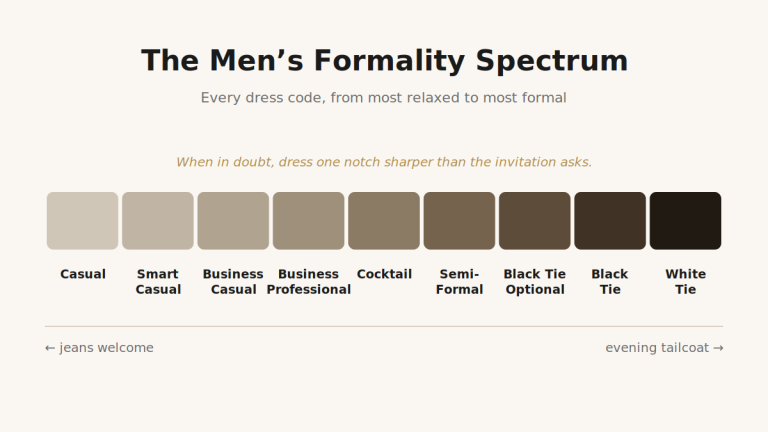
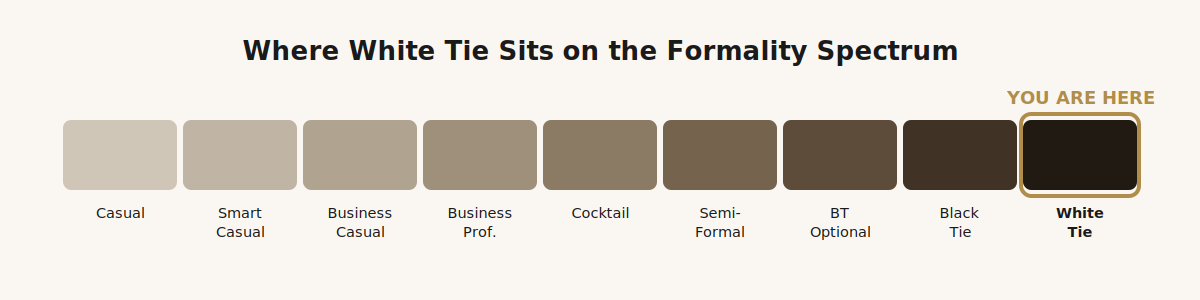
White tie sits at the very top of the men’s dress codes guide spectrum — one rung above black tie, and about as far from your everyday suit as clothing gets. Get the anatomy right once and you’ll never misread one of these rare, high-stakes invitations again.
What Is White Tie?
White tie is the most formal evening dress code in existence, built around a black evening tailcoat, a white piqué waistcoat, a wing-collar shirt, and a hand-tied white bow tie. Everything about it is prescribed: the cut of the coat, the fabric of the waistcoat, even the finish on the shoes. Where other codes give you choices, white tie gives you a specification.
That rigidity is the whole point. White tie exists to strip away individual expression in favor of a shared, ceremonial standard — when everyone in the room is dressed identically to the millimeter, the occasion itself becomes the thing on display, not the guest. Your job here isn’t to look interesting. It’s to disappear flawlessly into a tradition.
A Short History of Court Dress
White tie descends from early-19th-century court and evening dress, back when the tailcoat was simply what a gentleman wore after dark. The dandy Beau Brummell is usually credited with pushing the silhouette toward the clean, dark, sharply tailored lines we’d recognize today — a deliberate rejection of the fussy, embroidered court dress that came before it. By the Victorian era, the black tailcoat with a white waistcoat and tie had hardened into the standard uniform for formal evenings among the European upper classes.
Then came the rebellion that changed everything. In the 1860s the future King Edward VII commissioned a shorter, tailless dinner jacket for informal evenings — the garment that became the tuxedo and the foundation of black tie guide. As that easier alternative spread through the 20th century, it steadily displaced tails as the formal default. White tie didn’t disappear so much as retreat upward, surviving today only at the most ceremonial occasions — which is precisely why it still carries such weight.
The Anatomy of White Tie
Here’s the thing that trips men up: white tie is not “black tie, but more so.” It’s a distinct outfit with its own rules, and swapping in tuxedo parts is the fastest way to look like you didn’t understand the assignment. Let’s break the uniform down piece by piece.
The Evening Tailcoat
The tailcoat is the anchor, and it’s unlike any jacket you own. It’s cut to end at the natural waist in front — with no button that ever fastens — while the back extends into two long “tails” that fall to roughly the back of the knee. The lapels are peaked and faced in silk or grosgrain, and the whole thing is worn open, framing the waistcoat rather than covering it. The colour is black or midnight blue, and the fit across the shoulders is everything, because those shoulders are on permanent display.
One detail men always get wrong: the front of the coat should sit slightly above the bottom edge of the waistcoat, so a thin sliver of white shows beneath its front points. That relationship — coat, waistcoat, shirt — is the visual signature of the whole look.
The White Piqué Waistcoat, Wing Collar, and Bow Tie
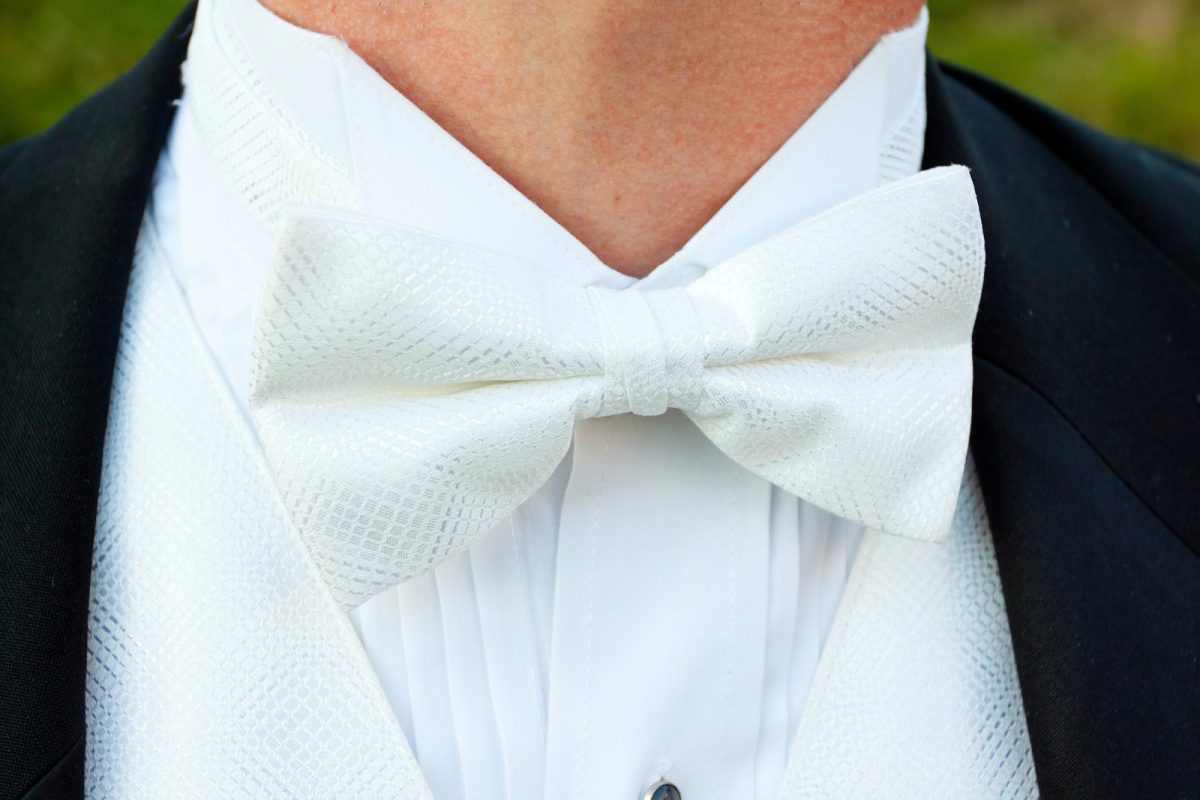
These three go together, and together they’re what make white tie white. The waistcoat is low-cut, made of white cotton piqué — a textured, waffle-weave fabric — and must sit above the front hem of the tailcoat, never peeking below it. The shirt has a stiff, detachable wing collar and a starched piqué bib worn with studs rather than buttons. And the bow tie is white piqué to match the waistcoat, hand-tied, always — this is the one code where a pre-tied bow isn’t just frowned upon, it’s a genuine tell.
The unifying material here is piqué, and matching it across the waistcoat and tie is the mark of someone who knows the rules (read: not someone who rented in a hurry). Get these three right and the rest of the outfit falls into line almost on its own.
Formal Trousers
The trousers are high-waisted and black to match the coat, carrying not one but two strips of silk braid down each outer seam — a subtle doubling that distinguishes them from the single-braid trousers of black tie. They’re worn with suspenders, never a belt; in fact there are no belt loops to be found. The high waist matters, because it keeps the trouser top hidden behind the waistcoat and preserves the unbroken line from bow tie to shoe.
Patent Leather Shoes
At floor level, the code calls for black patent-leather shoes — traditionally opera pumps with a grosgrain bow, though highly polished patent oxfords are widely accepted and easier to wear. The finish is non-negotiable: a mirror-like patent shine, no brogueing, no texture. Pair them with black silk over-the-calf socks so no bare shin ever shows. For the full range of formal footwear, our guide to black dress shoes for men covers what qualifies.
The Finishing Details
White tie is a code of small, prescribed extras. A white cotton or linen pocket square, folded simply. A set of matching studs and cufflinks in mother-of-pearl or white enamel, kept consistent across shirt and cuffs. Traditionally, white or grey gloves and a black silk top hat completed the picture — largely ceremonial today, but still correct at the grandest events. And since the trousers demand them, our guide on how to wear suspenders covers the button-on braces that formal trousers are built for.
White Tie vs. Black Tie
This is the comparison that matters most, because black tie is the code you’re far more likely to know — and the two look similar enough at a glance to cause real confusion. They are not interchangeable. White tie is a full step more formal, and the differences are specific.
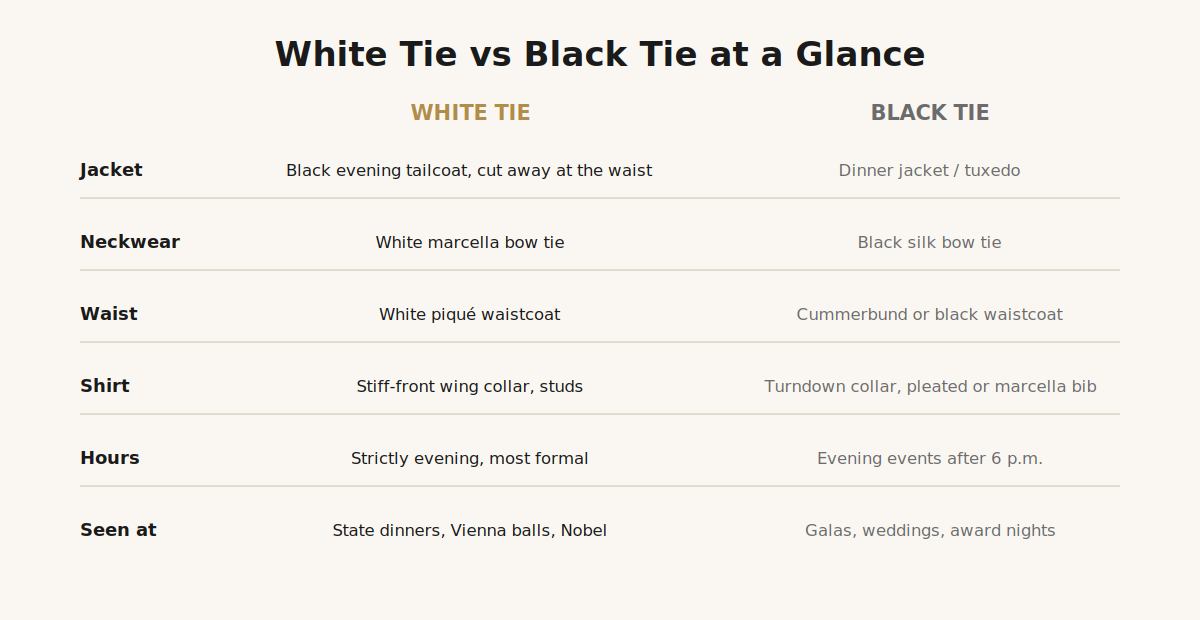
- The jacket. White tie means a tailcoat, cut to the waist in front with long tails behind and never buttoned. Black tie means a dinner jacket (tuxedo) that fastens with a single button and has no tails.
- The waistcoat and tie. White tie is white — a piqué waistcoat and a white bow tie. Black tie is black — a black bow tie, with a black waistcoat or cummerbund covering the waist.
- The shirt collar. White tie requires a stiff wing collar. Black tie allows a wing collar but more often uses a softer turndown spread collar.
- The trousers. White tie trousers carry two rows of braid; black tie trousers carry one.
- The formality. White tie is reserved for the rarest, most ceremonial occasions. Black tie is the everyday face of formalwear — weddings, galas, awards nights.
The simplest way to hold it in your head: if the waistcoat and tie are white, it’s white tie; if they’re black, it’s black tie. Everything else follows from there — and for the full picture of the more common code, our complete black tie guide breaks it down.
Where You’ll Actually Encounter White Tie
Here’s the reassuring part: you may go your entire life without needing white tie, and that’s completely normal. It survives now only in a handful of rarefied settings. State dinners and royal functions — a White House state dinner, a palace banquet — are among the last true strongholds. The grand Viennese ball season, the Opernball chief among them, still runs on strict white tie, and the Nobel Prize ceremony in Stockholm remains a reliable white-tie occasion each December.
Beyond those, you might meet it at certain old-guard university societies, formal debutante balls, or a wedding whose hosts are committed to the grandest possible standard. The common thread is ceremony and tradition — if an event isn’t leaning hard into either, it almost certainly isn’t white tie, no matter how fancy it sounds.
Renting vs. Buying
For the overwhelming majority of men, the answer is rent, and it isn’t close. White tie is worn so rarely — often once, sometimes never — that buying a tailcoat makes financial sense for almost no one outside of diplomats, conductors, and a certain slice of the aristocracy. A good formalwear house will fit you into proper tails, waistcoat, and shirt for a fraction of what the ensemble costs to own. Book early, because full white-tie kits are far scarcer than tuxedos, and prioritise the fit of the shoulders and the length of the tails above all else.
Buy only if white tie is a genuine recurring fixture in your life. If it is, invest in a properly tailored tailcoat in black or midnight blue — a well-made set of tails dates about as slowly as clothing can. For everyone else, a good rental worn with confidence beats an ill-fitting purchase every time.
The Mistakes Men Make
A few errors turn up again and again, nearly all of them from importing black-tie habits into a white-tie setting. The big ones:
- Wearing a black waistcoat or bow tie. The single most common mistake — it quietly downgrades the whole outfit to something that isn’t quite either code.
- A pre-tied bow tie. At this level, a clip-on is glaringly obvious and reads as a rental shortcut.
- The waistcoat showing below the coat. It must sit above the tailcoat’s front hem; a waistcoat peeking out underneath breaks the line.
- A turndown collar instead of a wing collar. Correct for black tie, wrong for white.
- A belt, a wristwatch, or anything flashy. White tie is a code of restraint; conspicuous accessories fight its entire logic.
Get the white waistcoat, the wing collar, the white piqué bow tie, and the tailcoat’s relationship to that waistcoat right, and you’ve cleared the bar that trips up nearly everyone else.
FAQ
Can you wear a black waistcoat to white tie?
No — a black waistcoat is a black-tie detail, and wearing it with tails puts you in a no-man’s-land that’s technically neither code. True white tie requires a white piqué waistcoat, matched to a white piqué bow tie. If a black waistcoat is your only option, you’re better off wearing the full black-tie ensemble correctly than assembling a half-white-tie hybrid — a clean, well-executed tuxedo reads far better than tails worn wrong.
Is white tie the same as “full evening dress”?
Yes. “Full evening dress” and “evening dress” on a formal invitation are older names for exactly the same thing: black tailcoat, white waistcoat, white bow tie. If you see those words, read them as white tie.
Do I really need a wing collar?
For strict white tie, yes — the stiff, detachable wing collar is part of the specification, not an optional flourish. It’s one of the clearest details separating white tie from black tie, where a softer turndown collar is perfectly acceptable.
What if the invitation says “white tie optional”?
Treat it as an invitation to rise to the occasion if you can, with a well-executed tuxedo as your respectable floor. “Optional” means the host will be delighted to see tails but won’t turn away a man in correct black tie.
The Takeaway
If you remember one thing, make it this: white tie is a specification, not a style, and your only real job is to execute it exactly — the white piqué waistcoat and tie, the wing collar, and the tailcoat sitting just above that waistcoat are what the entire code hangs on. You’ll rarely need it, but when you do, there’s no room to freelance, so rent well, fit carefully, and let the tradition do the talking. For the full map of when to wear what, head back to our men’s dress codes guide, and when your next invitation turns out to read the more familiar “black tie,” our complete black tie guide picks up right where this one leaves off.

Born and raised in Austin, David is a dedicated writer and avid fragrance lover. When he's not trying out perfumes, he enjoys traveling and exploring new restaurants.