Beach Formal & Garden Party Attire for Men: Dressing Up Outdoors

The sun’s dropping toward the water, someone’s uncorking rosé under a string of café lights, and the invitation in your pocket says two words that seem to argue with each other: beach formal. You want to look like you belong at this celebration, not like you wandered off a yacht catalog or, worse, a family barbecue. The good news is that dressing up outdoors follows its own logic once you stop treating it like an indoor dress code that happens to have sand nearby.
This post may have affiliate links, meaning we earn a small commission on purchases through the links (at no extra cost to you). This does not change our opinion but does help support the site. Thank you!
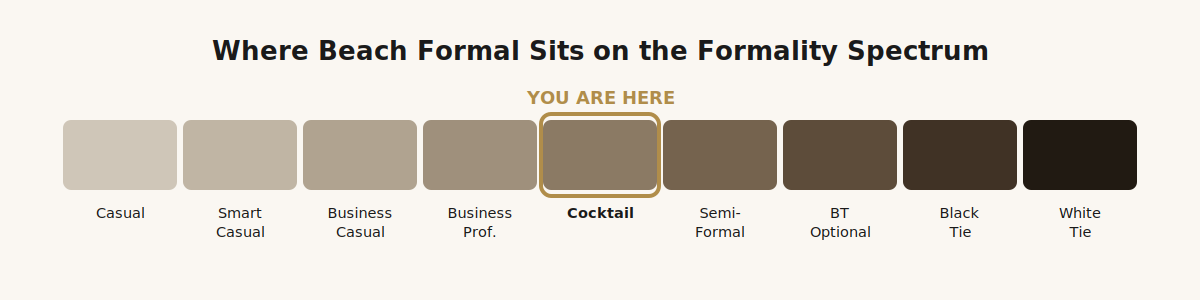
Both beach formal and garden party attire live in that tricky space between a suit and a swimsuit, and both reward the same instinct: keep the tailoring, ditch the sweat. If you want the wider map of where these codes sit relative to black tie, cocktail, and everything else, our men’s dress codes guide lays out the whole landscape — this guide zooms in on the warm, breezy, slightly barefoot end of it.
What Is Beach Formal Attire for Men?
Beach formal is the oxymoron everyone secretly enjoys. It asks for the silhouette of formalwear — a real jacket, tailored trousers, a considered outfit rather than a thrown-together one — executed in fabrics and colors that make sense with your feet in warm sand. Think formal shapes, resort materials.
The keyword here is silhouette. You’re keeping the structure that reads as dressed-up — the jacket, the clean lines, the intentionality — and swapping out everything that would cook you alive by cocktail hour. So the wool-and-lining playbook of a winter suit gets traded for linen, cotton, or an unlined tropical weave, and the black-tie palette gives way to light neutrals. It’s formal in posture, casual in temperature.
Practically, beach formal shows up on wedding invitations more than anywhere else, usually for ceremonies held on sand or a seaside terrace. The couple wants photographs that look elegant, not a guest list dressed for brunch. When in doubt, aim slightly above what feels necessary — a beach setting pulls every outfit down a notch automatically, so a bit of extra polish just lands you at “correct.”
Where the Code Comes From
Beach formal isn’t ancient, but its parts are. Resort dressing traces back to the early-20th-century leisure class decamping to the Riviera and Palm Beach, where the wool suits of the city simply didn’t work and lighter tailoring filled the gap — linen, flannel, and the loud cotton weaves that would eventually become seersucker’s whole reputation. The idea was always the same: bring the manners of tailoring to a place that’s too hot for its usual materials.
The garden party has an even older pedigree, rooted in English country entertaining and the summer social season, where hats, pale suits, and a certain relaxed formality were the uniform of an afternoon spent outdoors with a drink in hand. More recently, however, both codes have been rediscovered by a generation raised on destination weddings and a renewed appetite for reactionary prep — the tasseled loafers, the crisp collars, the sense that dressing up outdoors is a pleasure rather than a chore. What was once niche resort etiquette is now, more or less, how a lot of us spend our summer Saturdays.
The Beach Formal Formula
Here’s the outfit, part by part. Get these right and you’re covered before you’ve thought about a single accessory.
The Jacket and Trousers
Reach for a lightweight or unstructured suit — linen, cotton, or a tropical-weight wool that breathes instead of trapping heat. An unlined or half-lined jacket is the move, because full canvassing and heavy lining are exactly what turn a hot afternoon into a survival situation. A linen suit in a soft neutral is the beach formal workhorse, and if you want a deeper dive on wearing the fabric without looking like a wrinkled paper bag, our guide to the linen suit covers the whole ritual.
You don’t have to wear a matched suit, either. A pale odd jacket over lighter trousers reads perfectly for most beach formal invitations — pair a natural linen blazer with a clean pair of white trousers and you’ve got the code handled with room to breathe. Just keep the trousers tailored; sagging, over-baggy legs undo the “formal” half of the equation faster than anything.
The Shirt and the Tie Question
Go with a crisp cotton or linen dress shirt, ideally in white or a soft pastel. Whether you wear a tie is the defining choice of the whole code. The general consensus is that beach formal leans tieless — an open collar, maybe one button undone, is not only acceptable but often more correct than strangling yourself in silk on a humid beach.
If you want the security of a tie, a knit tie is your friend here. Its matte, textured, slightly casual character bridges the gap between “I made an effort” and “I understand where we are” — a silk tie with a high sheen can look a touch cornball against linen and sand. Leave the power ties in the closet with the wool suits.
The Footwear (and the Sand Rules)
Footwear is where beach formal gets genuinely funny, because the ground is actively working against you. On packed terraces or boardwalks, a pair of loafers is ideal — leather or suede, worn sockless or with no-show socks, barefoot-adjacent in spirit if not literally. Loafers are practically built for this code; if you’re shaky on how to pull them off without socks bunching or heels slipping, our guide on how to wear loafers sorts it out.
On actual loose sand, though, physics wins. Many beach ceremonies expect — even request — that guests go barefoot or in simple leather sandals for the ceremony itself, then slip shoes back on for the reception. Follow the couple’s lead; if the invitation says barefoot, arrive in something you can step out of gracefully rather than fighting your laces in front of everyone. As a note: whatever you wear, keep it clean and considered. Barefoot is a choice here, not an accident.
Garden Party Attire: The Dressier Cousin
If beach formal is the sun-bleached, tieless end of outdoor dressing, garden party attire is its slightly more buttoned-up relative — the version that happens on a lawn instead of a shoreline, with a bit more room for polish and play.
The core is still a lightweight suit or a smart odd-jacket combination, but the garden invites color and pattern in a way the beach rarely does. Pale blues, soft greens, warm tans, even a confident pink or a subtle check — all fair game, and often encouraged. This is the setting where a seersucker suit earns its keep; the puckered stripe is practically the official uniform of the summer lawn, and our take on how to wear a seersucker suit shows how to wear it without looking like a costume.
Garden parties also welcome the hat, which the beach mostly doesn’t. A woven Panama or a straw fedora is both genuinely useful under an open sky and a legitimate flourish of style — call it a bit rakish, in the good way. A tie is more expected here than at beach formal, though a knit or linen tie still beats anything heavy and shiny. The whole affair sits a half-step up in formality: same warm-weather materials, a touch more effort. If your garden party bleeds into the evening, it starts to overlap with summer cocktail attire, which is worth a read once the sun goes down.
The Fabric Guide
Materials do most of the heavy lifting in warm-weather dressing. Choose right and you’ll look put-together in ninety-degree heat; choose wrong and you’ll look — and feel — like you’re melting.
- Linen. The undisputed champion of hot-weather tailoring. It breathes beautifully, drapes with a relaxed elegance, and wears its wrinkles as a feature rather than a flaw (read: don’t panic about creasing — it’s the point). Ideal for both beach formal and garden parties.
- Seersucker. That puckered cotton weave lifts the fabric off your skin, so air circulates and you stay cooler than the thermometer suggests. It’s the most garden-party fabric there is, and it carries color and stripe with charm.
- Tropical wool. Don’t write off wool entirely. High-twist, open-weave tropical wool is engineered for heat — it’s more wrinkle-resistant than linen and holds a sharper line, which makes it a strong pick if you want structure without a sauna.
- Cotton. Chinos and cotton suits are the dependable middle ground: dressier than shorts, more breathable than heavy wool, and forgiving of a long afternoon on your feet.
The Color Palette
Warm-weather dressing wants light, and your palette should follow. Lean into the sun-washed end of the spectrum — off-white, cream, sand, stone, and the soft neutrals that photograph like the setting itself. These are your safest bets for beach formal, where a too-dark suit reads as a mistake.
From there, pastels earn their place: powder blue, sage, pale pink, buttery yellow. Garden parties give you the widest berth for color and pattern, so a confident tan suit or a checked linen jacket is right at home. The rule of thumb is simple — the outfit should look like it belongs to the season and the light around it. When you’re unsure, a lighter, cooler tone almost always beats a darker, heavier one.
What to Avoid
A few reliable ways to get it wrong, so you don’t:
- A black suit in full sun. It absorbs heat, reads funereal against a bright coastline, and photographs like a hole in the picture. Save it for the city and evenings indoors.
- Flip-flops and athletic sandals. Barefoot can be elegant; rubber flip-flops and Velcro sport sandals never are. If you’re wearing something on your feet, make it leather sandals or loafers.
- Sweat-trap fabrics. Heavy wool, polyester, and anything fully lined will betray you by the second round of drinks. If a fabric doesn’t breathe, it doesn’t belong here.
- Too-casual bottoms. Cargo shorts, distressed denim, and drawstring anything drag the whole look below the code. Tailored trousers are the floor.
- Overthinking the wrinkles. Linen creases — that’s its nature, not your failure. Chasing a crisp press all day will only make you miserable.
One finishing touch worth planning for: heat and fragrance don’t always cooperate. Reach for a lighter, fresher scent — citrus, marine, or a clean woody-aromatic — rather than a heavy fragrance that turns cloying in the sun, and your summer fragrance will read as considered rather than overpowering.
Can You Wear Shorts to Beach Formal?
Short answer: almost never. “Formal” is doing real work in the phrase beach formal, and tailored long trousers are the expectation — shorts, however smart, read as beach casual, which is a different invitation entirely.
There’s a narrow exception. Some destination weddings and resort celebrations explicitly set a relaxed tone and okay tailored shorts, in which case a pair of well-cut, longer-inseam chino shorts with a linen jacket, a crisp shirt, and loafers can work. But this only flies when the hosts have signaled it. When in doubt, wear the trousers — you can always look slightly overdressed for a beach, but you can’t un-arrive in shorts. If you’re piecing together a wedding-guest outfit specifically, our wedding guest guide walks through reading the invitation before you commit.
The Takeaway
Dressing up outdoors comes down to one decision, made twice: keep the formal silhouette, and let the climate choose the fabric. Nail those and beach formal or garden party attire stops feeling like a contradiction and starts feeling like the easiest, most pleasant way to dress all year. For the full range of codes and how they connect, head back to our men’s dress codes guide, and if your celebration leans dressier as the light fades, summer cocktail attire picks up right where this leaves off.

Born and raised in Austin, David is a dedicated writer and avid fragrance lover. When he's not trying out perfumes, he enjoys traveling and exploring new restaurants.